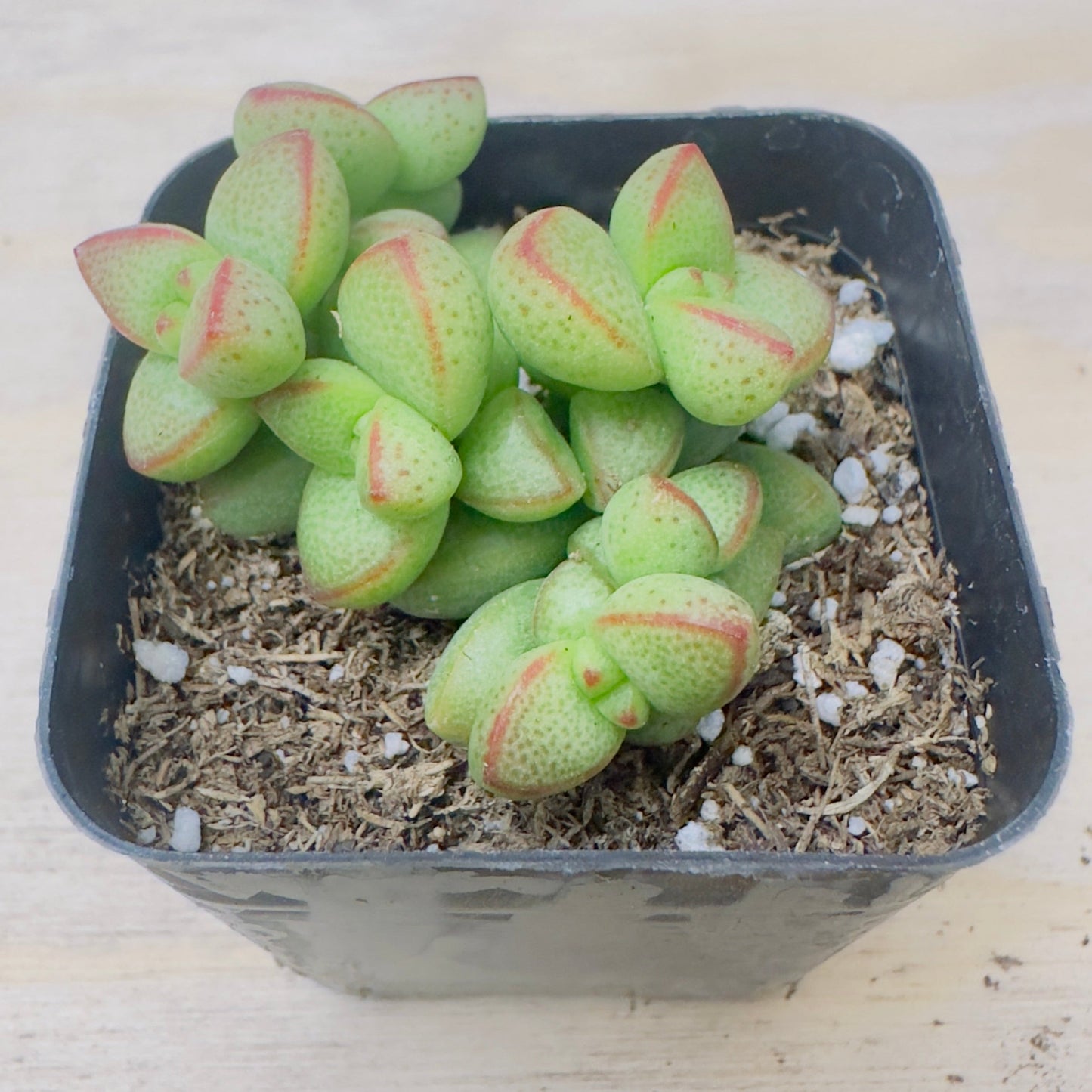
Crassula rupestris var. monticola
Crassula rupestris var. monticola
Sold by the tray. Buy 10+ trays for 50% off and no handling fee — applied automatically at checkout. Prices exclude sales tax, calculated at checkout; resellers can apply for exemption.
In stock
Product Details
Morphological Characteristics
Crassula rupestris var. monticola, commonly known as a variety of “Baby’s Necklace Vine” or “Rosary Vine,” is a small, stacked-leaf succulent in the Crassulaceae family. Native to mountainous regions of South Africa, it is known for its charming geometric form, compact size, and reddish margins.
The plant grows as a small, branching shrub with thick, triangular to ovate leaves that are tightly stacked in opposite pairs along upright or arching stems. Leaves are gray-green to pale green, often blushing pink or red around the edges when grown in bright sunlight or cool temperatures.
Mature stems may reach 10–20 cm (4–8 inches) long, and the plant gradually spreads into a compact mound or trailing cluster. In late spring or early summer, it produces small, star-shaped, pale yellow to white flowers in clustered heads at the tips of the stems.
Growth Habits
Crassula rupestris var. monticola is a slow- to moderate-growing, branching succulent. It can grow upright initially but tends to sprawl or trail over time, making it ideal for hanging pots, shallow planters, or rock gardens. It naturally forms dense mats in habitat, especially on rocky slopes.
Maintenance Points
-
Lighting: Needs bright light to full sun. Red coloration is enhanced in strong sunlight. Indoors, place near a south- or west-facing window.
-
Watering: Let the soil dry completely between waterings. Water sparingly in winter. Avoid water sitting in the leaf crevices to prevent rot.
-
Soil: Use well-draining succulent or cactus mix. Add sand or perlite for increased drainage.
-
Temperature: Best between 18–27°C (65–80°F). Not frost-hardy; minimum safe temperature is 5°C (41°F).
-
Fertilization: Feed monthly during active growing season with a balanced diluted succulent fertilizer. Skip feeding in winter.
-
Potting: Use shallow pots with drainage. Repot every 2–3 years to refresh soil or manage spread.
-
Humidity: Prefers dry conditions. Ensure good airflow around leaves.
Reproduction Method
Stem Cuttings:
-
Use clean scissors to cut a 5–8 cm (2–3 inch) stem with several leaf pairs.
-
Allow to callus for 2–3 days.
-
Plant in dry, well-draining soil. Water lightly after 4–5 days.
Offsets:
-
Mature plants may produce offsets at the base.
-
Separate gently, let dry, and plant as above.
Leaves:
-
Leaf propagation is possible but slower. Detach healthy leaves, let callus, then lay on dry mix and mist occasionally.
Additional Tips
-
Pest Control: Monitor for mealybugs and aphids. Treat with neem oil or insecticidal soap if needed.
-
Disease Prevention: Avoid overwatering. Ensure airflow and use breathable pots (e.g., terracotta) for improved drying.
-
Pruning: Trim leggy stems to encourage bushier growth. Use prunings for propagation.
-
Display: Excellent for rockeries, bonsai-style planters, succulent wreaths, and windowsills. Contrasts beautifully with rosette-form succulents.
-
Safety Note: Generally considered non-toxic, but best kept away from pets and children who might chew on leaves.
Care Notes
- Light: Bright, indirect light to gentle direct sun.
- Water: Water only after soil is fully dry.
- Handling: Unpack promptly and stage trays with airflow after delivery.
- Retail prep: Allow plants to settle before merchandising or repotting.
Shipping & Delivery
- Wholesale tray orders ship weekly from Rancho Cucamonga, California.
- Order cutoff is Friday at 5:00 PM PST for the following Monday shipment.
- Shipping rates are calculated at checkout based on order size and destination.
- Extreme weather may delay live-plant shipments. Heat packs are recommended during cold months.
- Inspect trays on delivery and report damage or DOA concerns within 48 hours.